gRPC Pipeline
When workers connect over gRPC, SMG runs the whole OpenAI-compatible serving pipeline itself. It renders the chat template, tokenizes, builds constrained-decoding grammars, detokenizes, extracts reasoning, parses tool calls, and runs MCP tool loops. Workers only run inference on token IDs. Workers on the ZMQ direct backend go through the same pipeline.
Overview
Chat Templates
Jinja2 chat templates for most models, plus native prompt encoders for DeepSeek-V3.2, V4 and V4.1 and Kimi-K3 checkpoints.
Tokenization Caching
Optional L0 (exact match) and L1 (prefix) caches skip re-encoding prompt content the gateway has already seen.
Reasoning Extraction
19 registered reasoning parsers move chain-of-thought into reasoning_content for DeepSeek, Qwen, Kimi, GLM, MiniMax, Nemotron, and more.
Tool Call Parsing
24 registered tool-call parsers turn each model family's native call format into OpenAI tool_calls. MCP tools run in the gateway.
Constrained Decoding
XGrammar structural tags and JSON schemas make forced tool calls and structured outputs match the declared schemas.
Pipeline Architecture
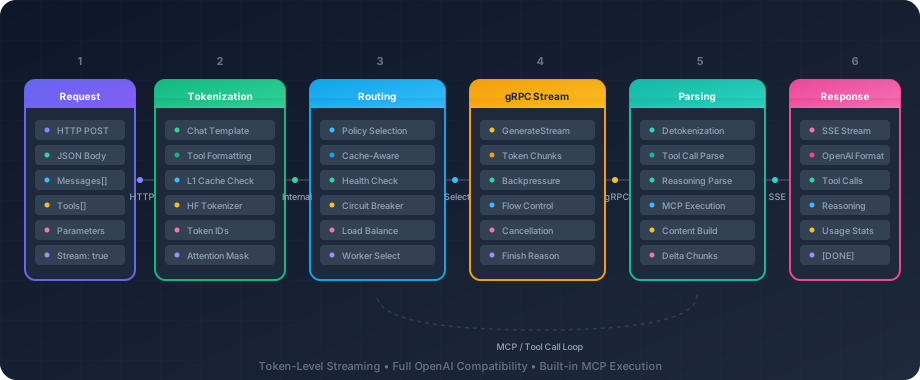
gRPC Mode
Gateway = Full Server
SMG handles tokenization, chat templates, tool parsing, MCP loops, and detokenization. Workers run raw inference.
HTTP Mode
Gateway = Smart Proxy
SMG handles routing, load balancing, and failover. Workers run full OpenAI-compatible servers.
Responsibility Comparison
| Capability | gRPC Mode (Gateway) | HTTP Mode (Worker) |
|---|---|---|
| Chat template | Gateway | Worker |
| Tokenization | Gateway (cached) | Worker |
| Constrained decoding (XGrammar) | Gateway builds, worker enforces | Worker |
| Cache-aware routing key | Token IDs from the gateway's tokenizer | Request text, or token IDs when the request is pre-tokenized |
| Reasoning extraction | Gateway | Worker |
| Tool call parsing | Gateway | Worker |
| MCP execution (Responses API) | Gateway | Not handled by the gateway |
The same pipeline serves Chat Completions, the Messages API and the Responses API. gpt-oss models use a separate Harmony pipeline. SMG selects it when a worker's model card lists the GptOssForCausalLM architecture or the gpt_oss model type, or when the model name contains gpt-oss. Harmony has its own encoding and output channels, so the chat templates and parser registries on this page don't apply to it.
Parser Selection
Every request resolves one tool-call parser and one reasoning parser for its model. SMG checks these sources in order:
- Per-model override: the
tool_parser/reasoning_parserof the model's card on its workers. - Gateway flag:
--tool-call-parser/--reasoning-parser, which applies to every model. - Automatic detection from the model name.
The gateway checks the flag values when it starts. An unknown --tool-call-parser or --reasoning-parser value stops startup with unknown tool-call parser '<name>' or unknown reasoning parser '<name>'; the pip smg launch rejects it earlier as an invalid choice. Names must match a registered parser exactly (deepseek_r1, not deepseek-r1).
Per-Model Overrides
The process-wide flags suit a gateway that serves one model family. To serve several families from one gateway, give each model its own parsers when you register its workers. Either form works:
- Labels:
tool_parserandreasoning_parserkeys in the worker'slabels. - Model card:
tool_parserandreasoning_parserfields on an explicit entry in the worker'smodelslist. An explicit card keeps its own values; labels only fill the fields it leaves empty.
curl -X POST http://localhost:30000/workers \
  -H "Content-Type: application/json" \
  -H "Authorization: Bearer ${ADMIN_TOKEN}" \
  -d '{
    "url": "grpc://coder-worker:50051",
    "models": [
      {"id": "my-coder", "tool_parser": "qwen_xml", "reasoning_parser": "qwen3"}
    ]
  }'
Registration fails if an override names an unknown parser (worker <url> declares unknown tool_parser '<name>' for model '<id>'). Workers of the same model should agree. If they don't, for example during a rolling upgrade, SMG logs a warning at registration and uses the lexicographically smallest name. Kubernetes service discovery sets no parser labels, so discovered workers rely on the flags. See the Admin API for the worker endpoints.
Automatic Detection
Without an override or a flag, SMG matches the request's model field against name patterns. It uses the canonical name, after model aliases resolve. Matching is case-insensitive and finds the pattern anywhere in the name, so Qwen/Qwen3.8-2.4T-A95B matches qwen3.8. The two registries break ties differently:
- Tool-call parsers: the longest matching pattern wins, so
deepseek-v4.1beatsdeepseek-v4. If nothing matches, SMG doesn't parse tool calls and returns the text ascontent. - Reasoning parsers: the first match in the reference table's order wins, which is why the specific DeepSeek, Qwen-thinking, Kimi and MiniMax patterns come before the broad
qwen,kimiandminimaxones. If nothing matches, reasoning stays incontent.
The reference tables under Reasoning Parsers and Tool Call Parsers list every pattern.
Chat Templates and Native Renderers
In gRPC mode the gateway builds the prompt text itself. Most models use a Jinja2 chat template. SMG takes it from a model card's chat_template path or --chat-template, then from a chat_template.json or .jinja file in the model directory, and finally from the chat_template field of tokenizer_config.json. Templates render with minijinja 2.24, so two Python Jinja2 behaviors work: conditional expressions inside keyword arguments (namespace(name=x if x else '')) compile, and booleans and none render as True, False and None (smg-project/smg#2277).
Native Renderers
Some checkpoints ship a Python prompt encoder instead of a Jinja template. For these, SMG uses a native Rust port of that encoder, tested against the reference output. The tokenizer picks the renderer from the config.json next to the tokenizer files. The DeepSeek and Kimi-K3 renderers replace the Jinja template entirely, so --chat-template has no effect on those checkpoints.
| Renderer | Selected when config.json has |
Thinking key (renderer default) | Native reasoning_effort values |
Notes |
|---|---|---|---|---|
| DeepSeek-V3.2 | architecture DeepseekV32ForCausalLM |
thinking (default off) |
None | Tools are attached to the leading system or developer message |
| DeepSeek-V4 | architecture DeepseekV4ForCausalLM |
thinking (default off) |
high, max (original checkpoints); low, high, max (0731 checkpoints) |
A native effort value turns thinking on |
| DeepSeek-V4.1 | architecture DeepseekV41ForCausalLM or model_type: deepseek_v41 |
thinking, or vLLM's enable_thinking alias (default on) |
low, high, xhigh, max, or an integer budget from 1 to 100 |
Continues a trailing assistant message natively with continue_final_message; reads tool-call arguments as written |
| Kimi-K3 | architecture KimiK3ForConditionalGeneration or model_type: kimi_k3 |
thinking (default on) |
low, high, max (default max; rendered only while thinking is on) |
Encodes the prompt piece by piece, so control-token text inside a message stays text; reads tool-call arguments as written |
| Kimi-K2.5 | architecture KimiK25ForConditionalGeneration or model_type: kimi_k25 |
From the Jinja template | None | Keeps the Jinja template, but renders tool declarations as TypeScript with a port of the checkpoint's tool_declaration_ts.py |
DeepSeek-V4 checkpoints share one config.json, but the 0731 refresh changed what the effort levels render. SMG tells the revisions apart from the checkpoint's encoding/encoding_dsv4.py. If that file is missing, it looks for a 0731 marker in the model path, and otherwise assumes the original encoding (smg-project/smg#2080). A request goes through SMG's DeepSeek request profile when a /-separated part of its model name is deepseek-v4-flash, deepseek-v4-pro, deepseek-v4.1-flash or deepseek-flash (in any case), as in deepseek-ai/DeepSeek-V4-Flash. The profile turns thinking on unless the request turns it off, which overrides the V4 renderer's default (smg-project/smg#2671). Kimi-K3 appends a response-channel stub after the assistant header. The engine receives the stub, but the prompt_tokens that clients see leave it out, matching Moonshot's billing (smg-project/smg#2564).
Thinking and Reasoning Effort
Reasoning controls reach the template as template variables. The request fields are documented in the OpenAI-Compatible API.
- Template kwargs:
reasoning_effort(orthinking.effort, which takes precedence),tool_choiceandresponse_formatare passed to the template as kwargs of the same name. An entry inchat_template_kwargsoverrides any of them. - Thinking on or off:
thinking.type(enabledordisabled) sets the preference. Without it, areasoning_effortof"none"or"minimal"means off. SMG writes the preference under the key the template actually reads:enable_thinking(Qwen3, GLM, Nemotron),thinking(DeepSeek, Kimi), orthinking_modeset to"enabled"or"disabled"(MiniMax-M3). A value you pass for that key inchat_template_kwargswins. - Native effort names: the DeepSeek-V4, V4.1 and Kimi-K3 renderers turn the values in the table above into their own effort prompt text.
- Parser arming: the reasoning parser follows the same decision. When thinking is on, it starts in reasoning mode, so the prompt and the parser agree.
Reasoning Parsers
Reasoning parsers separate chain-of-thought from the final answer. Models that emit thinking tokens before their response need one.
Configuration
| Option | --reasoning-parser |
|---|---|
| Default | Per-model override, otherwise auto-detected from the model name |
Supported Parsers
| Model family | Parser |
|---|---|
| DeepSeek-R1 | deepseek_r1 |
| DeepSeek-V3.1 | deepseek_v31 |
| DeepSeek-V4 | deepseek_v4 |
| DeepSeek-V4.1 | deepseek_v41 |
| Qwen3 and later hybrid-thinking Qwen models | qwen3 |
Qwen3 -Thinking checkpoints |
qwen3_thinking |
| GLM-4.5, GLM-4.7, GLM-5.x | glm45 |
| Kimi-K2 (Instruct) | kimi |
| Kimi-K2-Thinking | kimi_thinking |
| Kimi-K2.5 | kimi_k25 |
| Kimi-K3 | kimi_k3 |
| MiniMax-M2 | minimax |
| MiniMax-M3 | minimax_m3 |
| Nemotron Nano, Nemotron Super, Nemotron-3 family | nano_v3 |
| Command-R, Command-A | cohere_cmd |
| Step-3 | step3 |
| Inkling | inkling |
Complete Parser Reference
All 19 registered reasoning parsers, in auto-detection order (the first match wins):
| Parser | Auto-detected when the model name contains | Markers | Starts in reasoning |
|---|---|---|---|
deepseek_r1 |
deepseek-r1 |
<think> / </think> |
Yes |
deepseek_v41 |
deepseek-v4.1, deepseek_v41, deepseek-v41 |
<think> / </think>; a <|DSML| calls> tool block also ends reasoning |
No |
deepseek_v4 |
deepseek-v4, deepseek_v4 |
<think> / </think> |
No |
deepseek_v31 |
deepseek-v3.1, deepseek-v3-1 |
<think> / </think> |
No |
qwen3_thinking |
qwen3-thinking, qwen-thinking |
<think> / </think> |
Yes |
qwen3 |
qwen3, qwen |
<think> / </think> |
No |
glm45 |
glm45, glm47, glm-5 |
<think> / </think> |
No |
kimi_thinking |
kimi-k2-thinking |
<think> / </think> |
Yes |
kimi_k25 |
kimi-k2.5 |
<think> / </think> |
No |
kimi_k3 |
kimi-k3, kimi_k3 |
XTML think channel (<|open|>think<|sep|> ... <|close|>think<|sep|>) |
No |
kimi |
kimi |
◁think▷ / ◁/think▷ |
No |
step3 |
step3 |
<think> / </think> |
Yes |
minimax_m3 |
minimax-m3, mm-m3 |
<mm:think> / </mm:think>; stray </mm:think> markers before the answer are dropped |
No |
minimax |
minimax, minimax-m2, mm-m2 |
<think> / </think> |
Yes |
cohere_cmd |
command-r, command-a, c4ai-command, cohere |
<|START_THINKING|> / <|END_THINKING|> |
No |
nano_v3 |
nemotron-nano, nemotron-super, nano-v3, nemotron-3 |
<think> / </think> |
No |
inkling |
inkling |
TML typed blocks such as <|content_thinking|>; decoded with special tokens kept |
No |
base |
Not auto-detected | <think> / </think> |
No |
passthrough |
Not auto-detected | None; all text stays in content |
No |
"Starts in reasoning" is the parser's own default. The gateway also starts a parser in reasoning mode when a request has thinking on for a template or renderer with a thinking toggle, such as Qwen3, GLM, Nemotron, DeepSeek-V4 and V4.1, and Kimi-K3. The model's first tokens then count as reasoning.
Output Format
Reasoning separation is on by default (separate_reasoning defaults to true). The extracted text is returned in reasoning_content:
{
  "choices": [{
    "message": {
      "role": "assistant",
      "content": "The answer is 42.",
      "reasoning_content": "Let me think step by step..."
    }
  }]
}
Set "separate_reasoning": false in a request to leave the reasoning text in content. When streaming, a parser holds back text that might be the start of a marker, such as a trailing </thi. At the end of the stream it releases that text to the correct field instead of dropping it (smg-project/smg#2523).
Tool Call Parsers
Tool call parsers turn each model's native tool-call syntax into OpenAI tool_calls.
Configuration
| Option | --tool-call-parser |
|---|---|
| Default | Per-model override, otherwise auto-detected from the model name |
Supported Parsers
| Model family | Parser |
|---|---|
| GPT, Claude, Gemini, Gemma, and other Llama and GLM models that emit plain JSON | json |
| Llama 3.2 | llama |
| Llama 4 | pythonic |
| Mistral, Mixtral | mistral |
| Qwen2.5, Qwen3 | qwen |
| Qwen3-Coder, Qwen3.5, Qwen3.6, Qwen3.8 | qwen_xml |
| Nemotron-3 family (Nano, Super, Ultra, 3.5) | qwen_xml (alias nemotron) |
| DeepSeek-V3 | deepseek |
| DeepSeek-V3.1, DeepSeek-V3.2-Exp | deepseek31 |
| DeepSeek-V3.2 | deepseek32 |
| DeepSeek-V4 | deepseek_v4 |
| DeepSeek-V4.1 | deepseek_v41 |
| GLM-4.5, GLM-4.6 | glm45_moe |
| GLM-4.7, GLM-5.x | glm47_moe |
| Kimi-K2 | kimik2 |
| Kimi-K3 | kimi_k3 |
| MiniMax-M2 | minimax_m2 |
| MiniMax-M3 | minimax_m3 |
| Command-R, Command-A | cohere |
| Step-3 | step3 |
| Sarashina | sarashina |
| Inkling | inkling |
Complete Parser Reference
All 24 registered tool-call parsers. For auto-detection, the longest matching pattern wins. The last column shows the constraint sent for a forced tool_choice when the parser is set by --tool-call-parser or an override (see Constrained Decoding).
| Parser | Auto-detected when the model name contains | Format | Forced-call constraint |
|---|---|---|---|
passthrough |
Not auto-detected | No parsing; text is returned unchanged | JSON schema |
json |
gpt-4, gpt-3.5, claude-, gemini-, gemma-, palm-, llama-, meta-llama-, glm- |
{"name": ..., "arguments": {...}}, or an array of these (parameters is also accepted) |
JSON schema |
mistral |
mistral-, mixtral- |
[TOOL_CALLS] [{"name": ..., "arguments": {...}}] |
Structural tag |
qwen |
qwen |
<tool_call>{"name": ..., "arguments": {...}}</tool_call> |
JSON schema |
qwen_xml |
qwen3.5, qwen3.6, qwen3.8, qwen3-coder, nemotron-3 |
<tool_call><function=NAME><parameter=KEY>VALUE</parameter></function></tool_call> |
JSON schema |
qwen_coder |
Not auto-detected (alias of qwen_xml) |
Same as qwen_xml |
JSON schema |
nemotron |
Not auto-detected (alias of qwen_xml) |
Same as qwen_xml |
JSON schema |
pythonic |
llama-4, meta-llama-4, deepseek- |
[get_weather(city="SF"), ...] with Python literals |
JSON schema |
llama |
llama-3.2, meta-llama-3.2 |
<|python_tag|>{"name": ..., "parameters": {...}} (the tag is optional) |
JSON schema |
deepseek |
deepseek-v3 |
<|tool▁call▁begin|>function<|tool▁sep|>NAME followed by a fenced JSON block |
JSON schema |
deepseek31 |
deepseek-v3.1, deepseek-v3.2-exp |
<|tool▁call▁begin|>NAME<|tool▁sep|>{json}<|tool▁call▁end|> |
JSON schema |
deepseek32 |
deepseek-v3.2 |
DSML: <|DSML|invoke name="..."> and <|DSML|parameter name="..." string="true|false"> inside a <|DSML|function_calls> block |
JSON schema |
deepseek_v4 |
deepseek-v4 |
DSML inside a <|DSML|tool_calls> block |
JSON schema |
deepseek_v41 |
deepseek-v4.1, deepseek-v41, deepseek_v41 |
Spaced DSML: <|DSML| calls>, <|DSML| invoke ...>, <|DSML| parameter ...> |
Structural tag |
glm45_moe |
glm-4.5, glm-4.6 |
<tool_call>NAME, then <arg_key>K</arg_key> / <arg_value>V</arg_value> pairs on separate lines |
JSON schema |
glm47_moe |
glm-4.7, glm-5 |
<tool_call>NAME<arg_key>K</arg_key><arg_value>V</arg_value></tool_call> |
Structural tag, reasoning-aware |
step3 |
step3, step-3 |
<|tool_call_begin|>function<|tool_sep|><steptml:invoke name="..."> with <steptml:parameter> elements |
JSON schema |
kimik2 |
kimi-k2 |
<|tool_call_begin|>functions.NAME:IDX<|tool_call_argument_begin|>{json}<|tool_call_end|> |
Structural tag |
kimi_k3 |
kimi-k3, kimi_k3 |
XTML tools channel: <|open|>call tool="NAME" index="N"<|sep|> with argument elements |
Structural tag |
inkling |
inkling |
TML: <|message_model|>NAME<|content_invoke_tool_json|>{"name": ..., "args": {...}}<|end_message|> |
Structural tag |
minimax_m2 |
minimax |
<minimax:tool_call><invoke name="..."><parameter name="...">V</parameter></invoke></minimax:tool_call> |
JSON schema |
minimax_m3 |
minimax-m3, mm-m3 |
Every tag is prefixed with ]<]minimax[>[; parameters nest as XML elements |
JSON schema |
cohere |
command-r, command-a, c4ai-command, cohere |
<|START_ACTION|>{"tool_name": ..., "parameters": {...}}<|END_ACTION|> |
JSON schema |
sarashina |
sarashina |
[{'name': ..., 'arguments': {...}}] as a Python literal, with an optional <|tool_calls|> prefix |
JSON schema |
Parsing Behavior
- Schema-aware arguments: the XML-style parsers (
qwen_xmland its aliases,glm45_moe,glm47_moe,minimax_m2,minimax_m3) convert argument values to the types the tool's JSON schema declares.minimax_m3also resolves properties declared underoneOf,anyOforallOf. It turns an empty container element into[]or{}, and recovers the missing closing tag of an empty nested container (smg-project/smg#2370, smg-project/smg#2422, smg-project/smg#2567). - Special tokens: when a request carries tools and
tool_choiceisn'tnone, the gateway decodes with special tokens kept, so the parser sees its trigger tokens. Under a JSON-schema constraint the output has no trigger tokens, so the request's ownskip_special_tokensapplies. - Streaming: arguments stream as deltas. If a parser buffers text as a possible tool call and it never becomes one, the text is sent as
contentinstead of being dropped. Thejson,llama,mistral,qwenandcohereparsers do this (smg-project/smg#2271), as do the DeepSeek DSML parsers (smg-project/smg#2525) andminimax_m3, which releases a false tool-call start as soon as it can no longer match (smg-project/smg#2423).qwen_xmlkeeps each call's arguments separate, even when several calls arrive in one chunk or a value contains}(smg-project/smg#2490). - Tool call IDs:
call_plus 24 hex characters by default. For model names containingkimi, IDs follow the Kimi reference format instead:functions.NAME:N, orNAME_Nwhen the name also containsk3.Ncounts tool calls across the whole conversation (smg-project/smg#2104).
Tool Execution Flow
- Parse: the resolved parser extracts calls from the model output. Text outside the calls stays in
content. - Return: Chat Completions returns the calls in
tool_callswithfinish_reason: "tool_calls", unless the engine stopped forlengthor an error. The Messages API returnstool_useblocks withstop_reason: "tool_use". - Execute (Responses API): on
/v1/responses, the gateway runs calls to MCP tools itself, appends the results to the conversation, and resumes generation. The request'smax_tool_calls, capped by the gateway, bounds the loop. See MCP.
Constrained Decoding (XGrammar)
When a request forces a tool call or asks for structured output, SMG attaches a constraint to the gRPC request. The engine compiles it with its guided-decoding backend (XGrammar) and enforces it token by token, so the output matches the declared schemas before SMG's parsers ever see it.
Where It Runs in the Pipeline
In the regular gRPC pipeline, the tool constraint is generated after the prompt is rendered and tokenized (model_gateway/src/routers/grpc/regular/stages/chat/preparation.rs):
- Filter tools by
tool_choice - Render the prompt (chat template or native renderer)
- Tokenize
- Process multimodal inputs (see Multimodal Pipeline)
- Build the tool constraint (
generate_tool_constraint) - Build the stop decoder, then worker selection and dispatch
The Harmony pipeline (gpt-oss) builds its structural tags before encoding (model_gateway/src/routers/grpc/harmony/stages/preparation.rs). It rejects a request that combines a forced tool call with response_format.
When a Constraint Is Sent
| Request | Constraint |
|---|---|
No tools, or tool_choice is auto or none |
None. The parser extracts calls from free-form output |
tool_choice is required, names a function, or is allowed_tools with mode: "required" |
A structural tag when --tool-call-parser or an override sets a parser that has one; otherwise a JSON schema |
| Type | Parsers | What it constrains |
|---|---|---|
structural_tag |
mistral, deepseek_v41, glm47_moe, kimik2, kimi_k3, inkling |
The model's own format: trigger tokens, call framing, and argument JSON. The model-specific parser reads the result |
json_schema |
Fallback for every other case, auto-detected parsers included | Plain JSON. A named function constrains its parameters. required constrains an array of {"name", "parameters"} objects, with $defs merged across tools; conflicting definitions return 400 invalid_tool_configuration |
Two parsers add rules on top of their structural tag:
glm47_moe: when thinking is on, GLM-4.7-family templates end the prompt inside<think>. SMG then wraps the GLM tag in a reasoning prefix: free text that must close with</think>, with tool-call tokens excluded, followed by the forced call. The model reasons first, and the call can't end up inside the thinking block where the reasoning parser would absorb it. On SGLang workers the gateway then turns off SGLang's ownrequire_reasoningdeferral for that request (smg-project/smg#2550). GLM requests without tools, or withtool_choiceautoornone, carry no grammar (smg-project/smg#2549, smg-project/smg#2550).kimi_k3: each argument grammar carries the tool schema's$defs/definitionsblock, so parameters that use$refcompile instead of failing the request (smg-project/smg#2392).
Combining with Structured Output
A request carries at most one constraint. response_format becomes a JSON schema (json_object is {"type": "object"}), and text adds nothing. The regex and ebnf request extensions each add a constraint of their own. For SGLang, vLLM and TokenSpeed workers, the gateway rejects a request that sets more than one of these with 400 invalid_request_parameters. If a forced tool call applies as well, the gateway keeps the output-format constraint and drops the tool one for SGLang, TensorRT-LLM and TokenSpeed workers, and keeps only the tool constraint for vLLM workers.
Enforcement
The constraint travels in the request's SamplingParams.constraint oneof (crates/grpc_client/proto/). The oneof has json_schema, regex, ebnf_grammar (grammar on vLLM) and structural_tag fields, and vLLM also accepts json_object and choice. TensorRT-LLM receives the same constraint as GuidedDecodingParams. The engine needs a grammar backend to enforce it:
- TokenSpeed: start it with
--grammar-backend xgrammar. Its default is none. - TensorRT-LLM: set
guided_decoding_backend: xgrammarin its--extra_llm_api_optionsfile. - MLX: doesn't support constraints. It rejects a chat request with a forced tool call or a
response_format(400) and ignores the chatregexandebnfextensions.
See gRPC Workers for the launch commands.
Configuration
Parser CLI Options
| Option | Default | Description |
|---|---|---|
--reasoning-parser |
Auto | Reasoning parser for every model without a per-model override |
--tool-call-parser |
Auto | Tool-call parser for every model without a per-model override. Also opts the parser into structural-tag constraints |
--chat-template |
None | Jinja chat template file. Without it, SMG looks in the model directory. The DeepSeek and Kimi-K3 native renderers ignore it |
--mcp-config-path |
None | Path to MCP server configuration file |
MCP Integration
When MCP is configured, the gateway executes MCP tool calls on /v1/responses:
smg launch \
  --worker-urls grpc://worker:50051 \
  --model-path meta-llama/Llama-3.2-3B-Instruct \
  --tool-call-parser llama \
  --mcp-config-path /path/to/mcp.json
See the MCP Guide for detailed configuration.
Recommended Configurations
Thinking Model
DeepSeek-R1 with reasoning extraction.
smg launch \
  --model-path deepseek-ai/DeepSeek-R1 \
  --reasoning-parser deepseek_r1 \
  --worker-urls grpc://worker1:50051
Tool Calling Model
Llama 3.2 with MCP tool execution.
smg launch \
  --model-path meta-llama/Llama-3.2-3B-Instruct \
  --tool-call-parser llama \
  --mcp-config-path /config/mcp.json \
  --worker-urls grpc://worker:50051
Full Pipeline
Qwen3 with reasoning, tool calls, MCP, and tokenizer caching.
smg launch \
  --model-path Qwen/Qwen3-32B \
  --reasoning-parser qwen3 \
  --tool-call-parser qwen \
  --mcp-config-path /config/mcp.json \
  --tokenizer-cache-enable-l0 \
  --tokenizer-cache-enable-l1 \
--worker-urls grpc://worker:50051Monitoring
Pipeline Metrics
This pipeline records the metrics below. The smg_router_* series carry router_type="grpc"; the MCP metrics have no router_type label:
| Metric | Description |
|---|---|
smg_router_requests_total |
Requests routed, by model, endpoint and streaming |
smg_router_ttft_seconds |
Time to first token (streaming requests) |
smg_router_tpot_seconds |
Time per output token (streaming requests) |
smg_router_tokens_total |
Input and output tokens, by token_type (streaming requests) |
smg_mcp_tool_calls_total |
MCP tool invocations, by model, tool_name and result |
smg_mcp_tool_iterations_total |
Responses API tool-loop iterations |
See the Metrics Reference for every metric and label.
Debug Logging
RUST_LOG, when set, replaces the filter built from --log-level. Targets are crate and module paths. Keep a base level such as warn,smg=info so the rest of the gateway still logs:
# gRPC pipeline stages (preparation, worker selection, response processing)
RUST_LOG=warn,smg=info,smg::routers::grpc=debug smg launch ...

# Tool-call and reasoning parsers
RUST_LOG=warn,smg=info,tool_parser=debug,reasoning_parser=debug smg launch ...

# Tokenizers, chat templates and native renderers
RUST_LOG=warn,smg=info,llm_tokenizer=debug smg launch ...Troubleshooting
| Symptom | Cause | Solution |
|---|---|---|
Reasoning stays in content |
No reasoning parser matched the model name, or the request set separate_reasoning: false |
Set --reasoning-parser or a per-model override; compare the name with the patterns above |
Tool calls come back as text in content |
No tool parser matched, or the parser doesn't fit the model's format | Set --tool-call-parser or a tool_parser override for that model |
Gateway exits at startup with unknown tool-call parser or unknown reasoning parser, or the pip smg launch reports invalid choice |
The name isn't registered | Use a name from the reference tables above; names use underscores |
Worker registration fails with declares unknown tool_parser |
A label or model card names an unregistered parser | Fix the override name |
Forced tool calls or response_format not enforced |
The engine runs without a grammar backend | Start TokenSpeed with --grammar-backend xgrammar; give TensorRT-LLM guided_decoding_backend: xgrammar |
| MCP tools time out | Slow tool execution | Check MCP server configuration |